
What is NEET Exam?
The National Eligibility Entrance Test (NEET), formerly the All-India Pre-Medical Test (AIPMT), is the qualifying test for MBBS, BDS BAMS and BHMS programs in Indian medical and dental colleges. It is conducted by the independent autonomous and self-sustained premier testing organisation National Testing Agency (NTA).
The test was conducted by the Central Board of Secondary Education CBSE before NTA. The examination, which offers 90,000 seats in MBBS and BDS Colleges of India, is conducted in the month of May every year.
A candidate who wishes to study medical courses needs to have Physics, Chemistry, and Biology / Biotechnology as their compulsory subjects in Class 10th and 12th and must have passed these subjects. The candidate has to show their passing certificate at the time of the counselling round. Marks in Mathematics are not considered in the NEET-undergraduate exam (NEET-UG).
Other than undergraduate courses, NTA also administers NEET post-graduation (NEET-PG), an eligibility-cum-ranking examination prescribed as the single entrance examination for admission to various MD/MS and PG diploma courses.
If you want to take chance in government medical colleges direct admission MBBS in West Bengal, 1st you chose the best NEET coaching Institute in Kolkata. If you do a poor score on the NEET exam, then you can take MBBS admission abroad at a low price.
Dear NEET aspirants, are you ready for your NEET exam preparation? It is important to quickly learn about the exam pattern. Here is the necessary information to help you prepare.
The NEET UG question paper was conducted in offline mode with duration of 3 hours. It had 180 compulsory Multiple-Choice Questions (MCQs) covering Physics, Chemistry, and Biology, with a maximum score of 720. Each subject had separate sections with specific question counts.
Want to Pursue MBBS in West Bengal Kolkata India and Abroad?
MBBS is the dream career of so many medical students, however, only a few get the chance to reach this dream. Aspirants who want to prepare for the MBBS entrance must understand the fact that only NEET NTA is the single entrance for this exam. No other options are available to become a doctor and this single entrance test in India has the monopoly for medical courses admission. Gyankosh Academy is one of the best NEET coaching centers in Kolkata Howrah, we provide high-quality classes and qualified teachers.
The NEET (UG) 2027 exam will be online, as announced by the education minister.
The NEET exam pattern is primarily important for those preparing for the NEET UG exam. The exam held in offline (pen-and-paper) mode, lasting 3 hours. The paper contains 180 mandatory multiple-choice questions (MCQs) from three subjects: Physics, Chemistry, and Biology. Correct answers score +4 marks, and incorrect answers deduct -1 mark.Each subject will have a different number of questions, contributing to a total of 720 marks for the exam. Additionally, the NEET UG 2027 exam is set to be online, as mentioned by the education minister. Students are encouraged not to delay their preparation while waiting for new updates and to familiarize themselves with the 2026 exam pattern.
NEET 2023 EXAMINATION INFORMATION BULLETIN
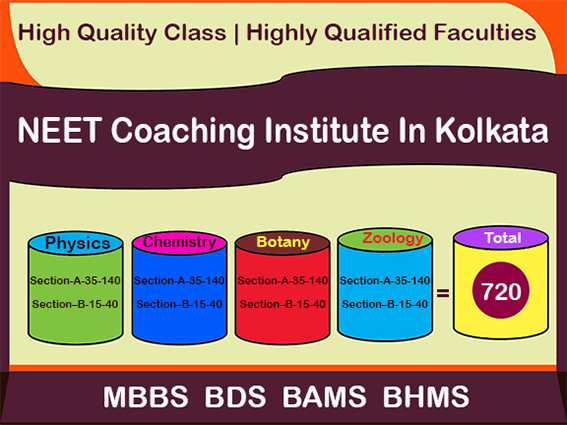
As per the NEET exam pattern, the questions in the medical entrance examination will be divided into two sections: Section A and B. Section A will contain 35 questions while Section B will have 15 questions. Of these 15 questions in Section B, candidates will have to answer 10 questions. Medical aspirants, who want to pursue MBBS, BDS, or other medical courses must be conversant with the NEET UG 2023 exam pattern along with their preparation efforts.
Understanding the NEET exam pattern in the early preparation stages is important to boost the level of preparation for the entrance test. The aspirants will find all details of the NEET exam pattern, the type of exam, mode of paper, language, duration, question type, and official marking scheme in the best NEET Coaching Institute in Kolkata. So, preparing for the exam will be inadequate without the proper help of a suitable coaching institute for the NEET examination.
NTA will conduct the NEET 2023 in pen and paper-based mode for a 3 hours 20 minutes duration, where candidates must answer Multiple Choice Questions (MCQs) from Physics, Chemistry, and Biology subjects as per the given NEET syllabus. Aspirants seeking more information regarding the NEET 2023 exam pattern can check the article below to know the level of the exam, the types, and the number of questions, marking schemes, and all other relevant information. The entrance test for NEET-UG is conducted in 11 regional languages. These subjects are Hindi, English, Urdu, Tamil, Telugu, Oriya, Kannada, Marathi, Gujarati, Assamese, Bengali
Bengali students can attend the NEET exam in their mother language. Do you want to do NEET Coaching in Howrah Kolkata? Gyankosh Academy is one of the leading NEET coaching centers in Kolkata. We have branches in the Howrah district at Ramrajatala and Belur.
NEET UG is the Gateway to Admission to Multiple Medical and Paramedical Courses:
In India, there are around 612 Medical, 323 Dental, 914 AYUSH, and 47 BVSc & AH colleges that will accept NEET 2026 scores. There is a total of 15 AIIMS and two JIPMER campuses that also accept this exam score for admission. This year, BSc (Hons) Nursing course admission will also take place through NEET but the seat matrix is yet to be released. As per the current data, there are 92,627 MBBS, 52,728 AYUSH, 27, 948 BDS, 603 BVSc, and 487 BSc nursing.
Paper Pattern for NEET 2027:
Mode of Exam | Online (should be expected) |
Duration | 3 Hours |
Number of Questions | 180 Compulsory Questions |
Type of Questions | Multiple-Choice Questions (MCQs) |
Total Sections | 1 per Subject |
Questions per Subject | Physics: 45, Chemistry: 45, Biology: 90 |
Total Marks | 720 Marks |
The aspirants will take the following medical and paramedical courses for the governmental and private hospitals when he will pass the exam successfully.
- MBBS
- BDS
- Ayurvedic Medicine
- Homoeopathy Medicine
- Unani Medicine
- Siddha Medicine
- Veterinary Sciences and Animal Husbandry
- BSc (Hons) Nursing
- Bachelor of Physiotherapy
- Bachelor of Occupational Therapy
- Bachelor of Audiology, Speech and Language Pathology
- Bachelor of Prosthetics and Orthotics.
Criteria for NEET Examination
- NEET is mandatory for Indian/Overseas candidates for admission to a medical University in India.
- Age Limit: The minimum age limit for NEET is 17 years on 31st December of the year of admission. There is no upper age limit for the NEET exam
- All India Quota seats: Foreign nationals and Overseas Citizens of India (OCI), NRIs, and Persons of Indian Origin (PIO) are entitled to the reservation under 15% All India Quota seats. J & K candidates are not eligible for 15% All India Quota seats.
- Qualification: The candidate who is appearing or has appeared in the 12th may apply for NEET. Their admission is confirmed only after clearing the 12th exam.
- Passed B.Sc. with any two of the Physics, Chemistry, Biology (Botany, Zoology)/Bio-technology from an Indian University.
- Passed the first year of the University’s three years degree course in PCB
- Number of Attempts – Candidates can attempt NEET as many times as they wish until they attain the maximum age limit.
NEET Exam Pattern 2025 Weightage of the Topics
This section of the blog about the NEET test pattern is designed to give you a clear understanding of how much each topic matters in NEET across all subjects. It is based on an analysis of the past 14 years of exams and will help you identify areas with higher weightage that need extra focus, enabling you to plan your studies more effectively.
SUBJECTS CLASSIFICATION WITH MARKS
Subjects Sections Number of questions Section-wise marks
Physics Section -A 35 140
Section – B 15 40
Chemistry Section – A 35 140
Section – B 15 40
Botany Section – A 35 140
Section – B 15 40
Zoology Section – A 35 140
Section – B 15 40
Total 720
SYLLABUS OF NEET-UG
NEET Physics Topic-Wise Distribution
Unit | Number of Questions NEET Physics | Topic-Wise Weightage |
Units and Measurements | 22 | 3.67% |
Scalars and Vectors | 7 | 1.17% |
Motion in a Straight Line | 19 | 3.17% |
Motion in a Plane | 26 | 4.33% |
Laws of Motion | 31 | 5.17% |
Work, Energy and Power | 26 | 4.33% |
System of Particles and Rotational Motion | 39 | 6.5% |
Gravitation | 33 | 5.5% |
Mechanical Properties of Solids | 13 | 2.17% |
Mechanical Properties of Fluids: Viscosity | 12 | 2% |
Mechanical Properties of Fluids: Surface Tension | 11 | 1.83% |
Thermal Properties of Matter | 12 | 2% |
Thermodynamics | 20 | 3.3% |
Kinetic Theory | 25 | 4.17% |
Oscillations | 24 | 4% |
Waves | 20 | 3.33% |
Electric Charges, Fields and Potential | 38 | 6.33% |
Electrostatics: Capacitance | 17 | 2.83% |
Current Electricity | 45 | 7.5% |
Moving Charges and Magnetism | 35 | 5.83% |
Magnetism and Matter | 14 | 2.34% |
Electromagnetic Induction and Alternating Current | 49 | 8.17% |
Electromagnetic Waves | 25 | 4.17% |
Ray Optics and Optical Instruments | 42 | 7% |
Wave Optics: Huygens Principle and Interference of Light | 16 | 2.67% |
Wave Optics: Diffraction and Polarisation | 12 | 2% |
Dual Nature of Radiation and Matter | 34 | 5.67% |
Atoms and Nuclei | 31 | 5.17% |
Semiconductor Electronics: Materials, Devices and Simple Circuits | 42 | 7% |
Experimental Skills | 9 | 1.5% |
NEET Chemistry Topic Distribution
Unit
Number of Questions NEET Chemistry
Topic-Wise Weightage
Some Basic Concepts of Chemistry
20
3.33%
Structure of Atom
25
4.17%
Classification of Elements and Periodicity in Properties
12
2%
Chemical Bonding and Molecular Structure
38
6.33%
Thermodynamics
27
4.5%
Equilibrium
45
7.5%
Redox Reactions
12
2%
p-Block Elements
13
2.17%
Organic Chemistry – Some Basic Principles and Techniques
32
5.33%
Hydrocarbons
41
6.83%
Solutions
31
5.17%
Electrochemistry
35
5.83%
Chemical Kinetics
31
5.17%
p-Block Elements (Group 15 to 18)
12
2%
d and f-Block Elements
37
6.17%
Coordination Compounds
36
6%
Haloalkanes and Haloarenes
27
4.5%
Alcohols, Phenols and Ethers
35
5.83%
Aldehydes, Ketones and Carboxylic Acids
38
6.33%
Organic Compounds Containing Nitrogen
27
4.5%
Biomolecules
22
3.67%
Principles Related to Practical Chemistry
3
0.5%
NEET Biology Topic Distribution
Unit | Number of Questions NEET Biology | Topic-Wise Weightage |
The Living World | 9 | 0.75% |
Biological Classification | 40 | 3.33% |
Plant Kingdom | 45 | 3.75% |
Animal Kingdom | 52 | 4.33% |
Morphology of Flowering Plants | 50 | 4.17% |
Anatomy of Flowering Plants | 42 | 3.5% |
Structural Organisation in Animals | 21 | 1.75% |
Cell: The Unit of Life | 62 | 5.17% |
Biomolecules | 49 | 4.08% |
Cell Cycle and Cell Division | 54 | 4.5% |
Photosynthesis in Higher Plants | 31 | 2.58% |
Respiration in Plants | 22 | 1.83% |
Plant Growth and Development | 32 | 2.67% |
Breathing and Exchange of Gases | 29 | 2.42% |
Body Fluids and Circulation | 37 | 3.08% |
Excretory Products and Their Elimination | 24 | 2% |
Locomotion and Movement | 32 | 2.67% |
Neural Control and Coordination | 14 | 1.17% |
Chemical Coordination and Integration | 38 | 3.17% |
Sexual Reproduction in Flowering Plants | 62 | 5.17% |
Human Reproduction | 47 | 3.92% |
Reproductive Health | 41 | 3.42% |
Principles of Inheritance and Variation | 79 | 6.58% |
Molecular Basis of Inheritance | 93 | 7.75% |
Evolution | 47 | 3.92% |
Human Health and Diseases | 45 | 3.75% |
Microbes in Human Welfare | 28 | 2.33% |
Biotechnology: Principles and Processes | 61 | 5.08% |
Biotechnology and its Applications | 42 | 3.5% |
Organisms and Populations | 39 | 3.25% |
Ecosystem | 26 | 2.17% |
Biodiversity and Conservation | 40 | 3.33% |
NEET Marking Scheme:
The NEET exam follows a strict marking system that rewards accuracy and penalises incorrect attempts. This means, the National Testing Agency (NTA) follows a negative marking scheme. This NEET negative marking system was also followed NEET UG examination.
Here’s a quick look at how marks are allotted in NEET
Correct Answer: +4 marks for choosing the correct answer.
Incorrect Answer: -1 mark for marking an incorrect option.
Multiple Correct Options: +4 marks are awarded to those who select any of the correct options if multiple options are correct.
All Correct Options: +4 marks are given to all candidates who attempt the question when all options are correct.
Dropped/Invalid Question: If none of the options are correct or the question is wrong/dropped, +4 marks are awarded to all candidates, whether or not they attempted the question.
So, be careful with your answers—one wrong attempt can cost you valuable marks! Accuracy matters more than speed.
Expected NEET Exam Pattern 2027 and Total Marks
Since, NEET (UG) 2027 might be conducted online, that is CBT Mode, we cannot speculate the exact NEET paper pattern until the NTA officially releases one.
But we can definitely understand the basics, based on the NEET 2026 exam pattern number of questions marks. As a NEET candidate, you must be aware of the NEET paper marks distribution. The NEET exam total marks is 720 marks, with 180 questions worth 4 marks each. Below we have mentioned NEET marks distribution and NEET question pattern subject-wise.
Section A: This section includes 45 questions each in Physics, Chemistry, Zoology, and Botany, with no choices—you must answer every question. This section is worth a total of 180 marks (45 questions × 4 marks each).
In total, Physics, Chemistry, and Biology (Zoology + Botany) together add up to a NEET total mark of 720. Biology alone is worth 360 marks, as it includes both Zoology and Botany.
NEET Exam Pattern Language Options
The NEET exam was held in 13 different languages across all the exam centres in India and abroad. There are some key factors mentioned below to remember while choosing the language for your NEET exam:
You can choose the question paper medium from the languages mentioned below:
English, Hindi, Assamese, Bengali, Gujarati, Malayalam, Kannada, Marathi, Odia, Tamil, Telugu, Urdu, or Punjabi.
You choose your language medium while filling out the form. After you make your selection, you can’t change it later.
The particular selected language will be mentioned in the NEET exam.
If you choose English language, you will then receive an English booklet.
If you choose Hindi language, you will then receive a bilingual test booklet in Hindi and English.
If you go for vernacular languages, then you will get a bilingual test booklet. One in the chosen language and the other in English.
If there’s any uncertainty in the translation of any question, then the English version will be considered as the final reference.
NEET Exam Question Paper Difficulty Level
As per the experts and candidates, the difficulty level of the question paper in the NEET exam was a balanced and moderate difficulty level rather than an extremely easy or difficult one. Biology remained strongly NCERT-oriented, Chemistry emphasised conceptual application, and Physics tested conceptual understanding alongside numerical problem-solving. Overall, if you had prepared consistently, revised regularly, and practised PYQs and mock tests, you would have found the exam manageable and scoring.
Ways to Avoid Negative Marking in the NEET Exam
The existing NEET exam pattern has a negative marking system. For one incorrect answer, 1 mark gets deducted. Take a look at these general tips that could help you avoid common mistakes and the NEET negative marking system:
Avoid guessing answers without logic.
Read each question carefully before you choose your answer to avoid negative marking.
Practising multiple mock tests helps you develop your NEET exam strategy, reduce last-minute stress, and answer questions more carefully.
NEET UG Updated Syllabus
Are you aware that the National Medical Commission (NMC) released the updated syllabus for the NEET UG Exam on its official website in 2025? The updated syllabus of NEET features new topics and some removals, distinguishing it from previous versions. As a NEET 2025 aspirant, it’s essential to familiarise yourself with these updates to shape your study plan. Hence, we have discussed these changes in further detail in our NEET Syllabus. These changes aim to improve your grasp of important concepts, helping you prepare effectively for a future in medicine.
Conclusion
While there is still uncertainty surrounding the NEET UG 2027 exam pattern due to the proposed changes, this should not slow down your preparation. The syllabus remains unchanged, and so should your commitment and strategy. Remember, it is only the mode of examination that is expected to change—not the knowledge, concepts, and problem-solving skills that NEET tests. Stay consistent, trust your preparation, and focus on building a strong foundation.
 English
 العربية
 বাংলা
বাংলা 简体中文
简体中文 हिन्दी
 मराठी
मराठी नेपाली
 தமிழ்
தமிழ் اردو
اردو